The Great Matu Posaka - Part I
There once lived in ancient India a wise and kind king named Vedeha. His kingdom, Kasi, stretched from the river Ganges to the snowcapped Himalayan Mountains. King Vedeha being a very able ruler, was able to develop his kingdom very rapidly. Its capital also named Kasi (known today as Varanasi or Benares), became a famous trading center.
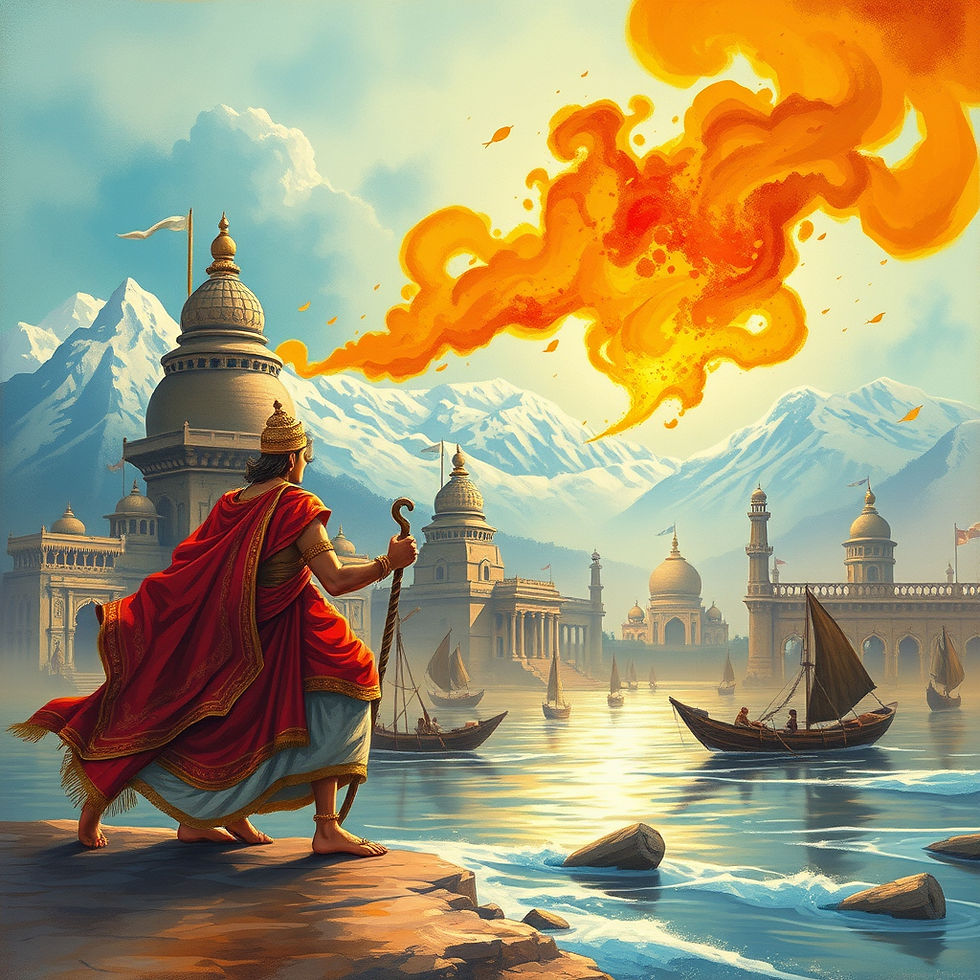
Merchants travelled to the city of Kasi from as far as Greece, Rome, and Persia in the West and from China, Korea and Japan in the East to trade their goods. They also came to buy the locally produced famous cotton and silk textiles.
As trade expanded, people from many countries began to settle in Kasi. It was delightful to see foreign traders in their various colorful traditional dresses. Their houses too were built of different designs and styles that made Kasi a uniquely colorful city where different peoples lived in harmony and peace.
At that time, there lived a large herd of elephants in the jungles of Chandragiri located at the foothills of the Himalayas. Its leader, Saccaka (Truthful One), was highly respected by the rest of the herd. He was well built, strong and brave. Above all, he was very caring and looked after the herd like a father.

Saccaka was also held in high regard for his deep knowledge of the ancient science of living a wholesome and healthy life. This involved both the growth of the physical body and nurturing of the mind. The ancient wisdom on wholesome living was passed down from his forefathers from one generation to the next.
Saccaka loved his mate, Kanthi (Patient One), very dearly. He never failed to look after her needs and respect her feelings. On her part, Kanthi remained a very devoted and loving companion. She regarded Saccaka as her most trusted friend in life and shared everything with him. Her loyalty and love towards him were praised by the other elephants. The truly loving couple dearly longed for a calf of their own.
One day, Saccaka told Kanthi that he would go and search for fertility herbs that will help her to give birth to a calf. He tracked deep into the thick jungle for several hours. But he did not come across any fertility herbs for his dear mate. He was so tired that he felt like giving up and return home. Yet, deep down inside Saccaka knew that he could not face Kanthi empty handed. So, despite being exhausted, he continued to search for that elusive fertility herb.
As good fortune would have it, he finally stumbled upon a clump of the rare bluish fertility herb, growing at the foot of a huge tree. This was the best fertility herb that one could ever wish for. His heart was filled with great excitement at the precious discovery. He quickly rushed back home to feed Kanthi the rare herb while the leaves were still fresh and juicy.
Kanthi’s heart was filled with delight on seeing the rare fertility herb that Saccaka had brought. She gave him a huge hug to express her appreciation of his devoted spirit and love for her.
About two months later, Kanthi experienced the signs of pregnancy. Saccaka was so happy that he trumpeted and danced as he shared the wonderful news with the rest of the herd. Elephants practice the most beautiful culture of samagga or kinship where everyone lived as one big family and shared each other’s joys and sorrows as a natural way of life.
Another great quality among elephants is how they honour motherhood. They regard motherhood as a most sacred mission of giving birth to a new life. Saccaka was mindful of the ancient wisdom of Gabbha Parihara, that is, the science of holistic motherhood. This practice ensured the healthy physical growth of the unborn calf as well as its emotional, mental, moral and ethical development.

Saccaka fully understood the great importance of lovingly nurturing the mind of the yet-to-be-born baby. He was ever mindful of how pre-birth experiences influence the thinking, character and behaviour of their unborn calf in adult life.
Bearing in mind the ancient science of motherhood, Saccaka attended to Kanthi’s needs like a truly loving husband and father-to-be should. He took great care to ensure that his expecting mate was always in a cheerful spirit and free from stress. He daily saw to it that she ate well for herself and their unborn calf.
Aside from these loving and caring acts, Saccaka gave Kanthi every encouragement to go through her pregnancy with Sraddha or confidence. As a result, her adhittana (resolute determination), viriya (positive effort) and kanthi (patience) that are so essential for coping with the hardships and sacrifices involved in childbirth were greatly strengthened.
Throughout Kanthi’s twenty-two months-long pregnancy, Saccaka saw to it that she was in a calm, relaxed and happy mood. Before retiring for the night, he would place his long trunk over her belly and radiate metta (unconditional friendliness or boundless goodwill) to their unborn calf. Together, the loving couple would express their pathana (aspiration) to be blessed with a healthy and noble offspring.
To strengthen Kanthi’s sraddha, Saccaka guided her daily to sit quietly and visualize the birth of a truly unique calf. Both of them would sing soothing lullabies to calm their unborn calf. They invoked the blessings of the Devas (heavenly beings) daily for its protection and well-being. At the same time, they never failed to express regularly their patthana thus, “Dear precious child, may you be a noble elephant. May you be strong and healthy, born in terms of your body and mind.”
Just as the loving parents had devoutly prayed for, they were blessed with a magnificent calf. His eyes were bright and beautiful like two lotus petals. Golden hair sprouted all around his radiant body.
The caft was truly amazing. Saccaka and Kanthi wept with joy. The birth of their calf was the greatest day of their lives. It was so touching to see Kanthi gaze at her calf with deep motherly love and nurse him tenderly.
The happy parents named him Dhanapala, meaning Virtuous One. They chose a special day to announce their calf’s name to the herd. The whole elephant herd turned up for the Naming Ceremony. It was such a joyous celebration for the herd to welcome the new-born calf into the community. Before taking their leave, the guests congratulated the happy and proud parents. They wished Dhanapala every success, well-being and happiness.
The loving couple and their new-born calf was a perfect picture of a happy family. Dhanapala was such a wonderful bundle of joy. Both Saccaka and Kanthi understood the ancient wisdom of Pubbacariya. They took to heart its central teaching that parents are the first and foremost teachers.
Saccaka and Kanthi dutifully paid special attention to teaching and grooming their calf, especially in the first six years. They understood that this period was vital for moulding his thinking, attitude and behaviour. So, the loving and caring parents spent a great deal of joyful quality time with their infant Dhanapala throughout the day.
Both parents took great effort to instill in Dhanapala good thoughts from infancy. In particular, they taught him family values, such as the joy of honouring parents and looking after them in their old age. Without question, infant Dhanapala benefitted greatly from their guidance on how to live a purposeful noble life.
Young Dhanapala proved a very intelligent and keen learner. He possessed an inquiring mind and probed about the many interesting things he came across as he grew up. Once he asked his father, “Dear Pappa, what is lifelike beyond this thick jungle?”
Saccaka thought long and hard for a while. He then explained to Dhanapala very patiently that the people who lived beyond the jungle in villages and towns were dangerous. They captured elephants to work for them. He warned him that some were so heartless that they even killed elephants just to sell their body parts, especially their tusks and hide.
Saccaka advised Dhanapala not to trust human beings because of their horrible greed. He promised to explain more about this matter when he grows up. In the meantime, he was to stay close to the herd and learn the ways of elephant thinking and behaviour.
Dhanapala was ever so grateful for the unconditional love his parent’s showered upon him from the day he was born. Even as a young calf, he often expressed his boundless love towards them. He vowed to devote his life to taking care of his dear loving parents in their old age. But just as Dhanapala was growing up, tragedy struck a dreadful blow. Saccaka fell seriously ill and died after a few days.
Dhanapala felt that his whole world had crumbled. He cried and cried until there were no more tears to shed. The elders gathered around to console the bereaved Dhanapala and his mother. They took him aside and advised him that life was uncertain and impermanent. They told him to be brave and accept death as a reality of life that everyone had to face one day.
Kanthi too was devastated. Her peers gathered to comfort her. They advised her to be courageous for Dhanapala’s sake. They pointed out that he was still a youngster and needed her close attention. All of them assured her that she could confidently count on their support in bringing up Dhanapala.
The deep-rooted herd culture among elephants was a great source of hope and strength for Kanthi in her sorrow. Elephants have a marvelous culture of collectively looking after the interest, welfare and security of the whole herd. The elder elephants looked after Dhanapala like their own offspring. This was such a relief for widowed Kanthi.
Dhanapala grew up to be a physically strong and intelligent elephant. He was also very popular among the herd because of his metta. He was ever so thoughtful, kind and helpful to everyone. Though he was easily the strongest among his peers, he was never boastful. Instead, just like his late father, he was modest. It was not at all surprising that he soon became the darling of the young elephants.
There was, however, a peer nicknamed, Koroda (Angry One), who was very jealous of Dhanapala’s superb qualities, good character, outstanding abilities and wide popularity. Unlike Dhanapala, he was rude and haughty. The few friends he had were crude in character, just like him. They took great pleasure in bullying younger elephants and behaving rudely. One day, just out of the blue, Koroda challenged Dhanapala to a Tree Uprooting Contest. But Dhanapala was not interested in a contest as he understood that this could create disharmony in the herd. However, after much persuasion by his friends on the need to teach the crude bully, Koroda, a lesson; he reluctantly took up the challenge.
The cunning Koroda quickly chose a young tree that grew nearby for him to uproot. He singled out a much larger and stronger tree for Dhanapala. True to his good nature, Dhanapala did not object to Koroda’s unfair selection of the trees.
The two contestants coiled their respective trees with their trunk tightly. On the count of three, both took a deep breath and began to lift their allocated tree.
Dhanapala succeeded in uprooting his tree quite easily. Koroda, however, took a longer time. He felt terribly ashamed over his defeat and bolted from the scene. He ran straight to his father, Agnika whose name meant the, “Fiery Hot Tempered One” and cried like a little calf.
Agnika comforted Koroda and asked him not to sulk for this would only earn him the scorn of the herd. He swore to train him to be strong. He advised his son confidently:
I will train you to be so strong that you will be the champion of the herd. The leader of the herd is already old. Soon, a new leader will be chosen. You will then replace him. Now freshen up and get ready for my personal coaching session.
Just as Agnika had predicted, a few years later, the leader of the herd died of old age. According to the elephant code, the Council of Elders met to select a suitable successor. The oldest member proposed Dhanapala as the best to lead the herd. All the other members raised their trunks to acknowledge their approval.
However, Agnika stepped forward and expressed his strong objection. He claimed that Koroda was far more qualified than Dhanapala to be the new leader. Therefore, the only way to decide on who should be the new leader is by holding an open contest of strength.
The members of the Council of Elders looked at each other in disbelief. Agnika nevertheless insisted on a tug-of- trunks contest to determine who should rightly be the new leader of the herd. Following the elephant custom, the Elders had no choice but to agree to his adamant demand to hold an open contest.
At the contest grounds, Dhanapala and Koroda took their respective positions on either side of the demarcation line. They locked their trunks firmly in readiness for the referee to signal the start of the great tug-of-trunks contest. The atmosphere was tense. The referee began to count to three. But, just before the count of three, Koroda cheated and tugged Dhanapala forward. The unexpected jerk caused him to lose his footing. The elders who favored Dhanapala lost a heartbeat. Fortunately, Dhanapala quickly regained his balance and dug his heels firmly into the ground. He then took a deep breath and swung Koroda who went tumbling forward right across the line, like a huge boulder.
Dhanapala was declared the undisputed winner of the contest. The elders joyfully trumpeted his victory for they were sure that he would prove a better leader. Kanthi felt so proud of Dhanapala. She recalled the adhittana which she and her late beloved Saccaka had piously made daily for Dhanapala to become the leader of the herd. She advised him:
Son never let pride get into your head. Live up to the family’s high honour. You must always uphold the good name of your late father. He was dearly respected by the herd for his noble qualities and wonderful compassion nature.
Dhanapala took to heart the guidance his parents had imparted to him from a young age. He followed his father’s noble principle of leading the herd by example. He showed great confidence and courage in facing dangers posed to the herd.
Everything was going well for Dhanapala and his mother. But about a year later, tragedy struck the family once again. Kanthi became blind due to an incurable eye disease. She could no longer get around on her own. Dhanapala looked after his blind mother day and night with boundless love. He fed her the finest food daily. He was so devoted to her that he would not take even a morsel of food until he had fed and nursed her lovingly. He drew immense joy in looking after his blind mother.


Comments