The Great Matu Posaka - Part II
The wicked Agnika and Koroda saw Dhanapala’s devout caring of his blind mother as a golden opportunity to criticize his leadership. They spread spiteful lies about him. They accused him of being more interested in his mother’s welfare than that of the herd. They coaxed their clique of ill-mannered elephants to tease him, “Matu Posaka” which means, “One who feeds his mother”. The harassments did not deter Matu Posaka from feeding and nursing his blind mother. In the course of time, more elephants began to complain about Dhanapala’s devotion towards nursing his blind mother. They too began to mock him by his nick name that stuck ever since.
Agnika and his cruel clique protested to the council of Elders to appoint a new leader. At that point, the humble Matu Posaka felt that it was best for him to give up the leadership of the herd and devote his time totally to looking after his dear mother. He explained to her about the change of heart among some of the elephants and his decision to leave the herd.
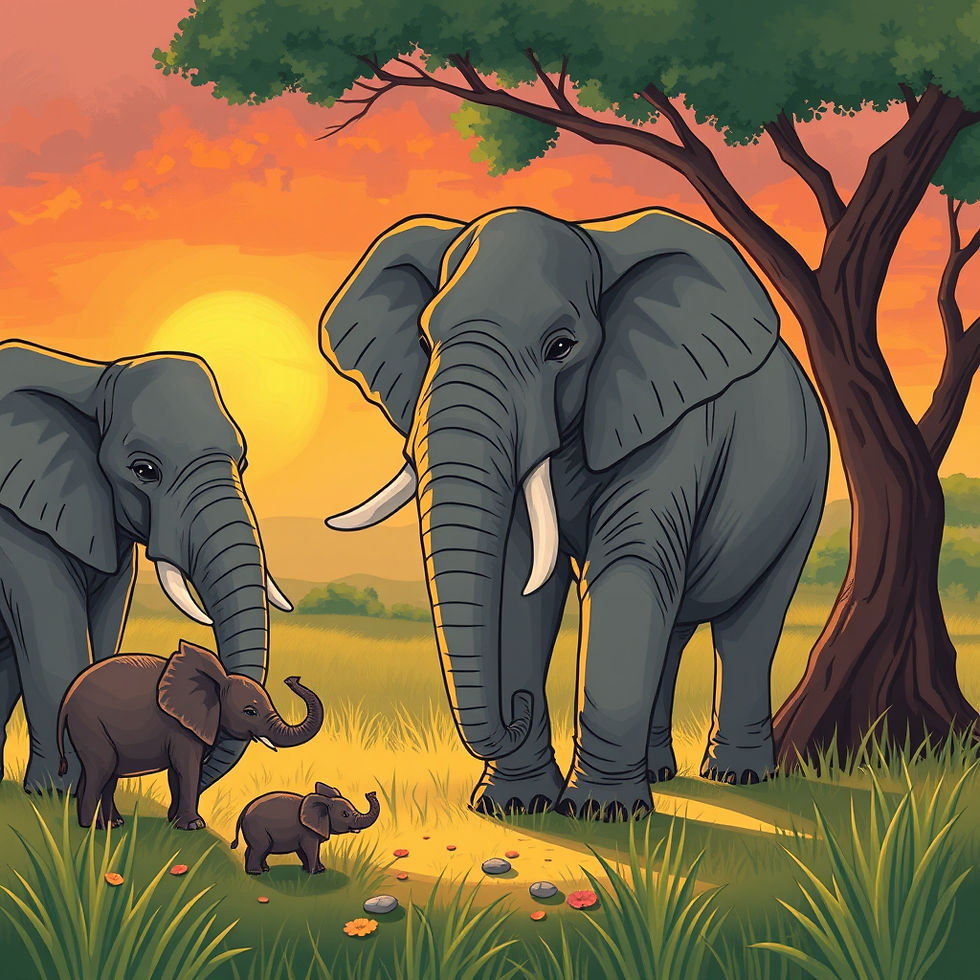
Early the next morning, Matu Posaka and Kanthi bade a sad farewell to their relations and close friends. With a heavy heart, Matu Posaka led his mother deep into the jungle. After a long track, they came to a quiet secluded grassy plain at the foot of the snow-capped Himalayan Mountains. The valley was surrounded by a variety of fruit trees. A huge lake filled with beautiful lotuses stood radiantly at the center.
Matu Posaka was simply amazed by the breath-taking beauty and richness of the valley for grazing. He gently led his mother to rest under a shady grove of Deodar trees. Next, he gathered some branches from a nearby Margosa tree and wiped off the dirt that had collected on the body as they tracked through the jungle since early morning. He then collected food for his mother and fed her as usual. In the evening, he led her to the lake to bathe.
Kanthi felt refreshed after her bath in the cool waters of the lotus-filled lake. Just as the sun was about to set, Matu Posaka and his mother returned to the grove of deodar trees to retire for the night. When they reached their new home, they were pleasantly surprised by a warm welcome reception by the animals living in the isolated valley. The exclaimed in a chorus: “Welcome to Candorana! We are delighted to have you as part of our caring community. Please feel at home in our friendly habitat.”
Matu Posaka and Kanthi were deeply touched by the sincere friendship and goodwill of the animals of the valley. Though they were total strangers, the animals could sense the nobleness in them. They genuinely wanted both of them to feel a true sense of belonging with the community.
Matu Posaka and Kanthi spent happy times with the animals of Candorana. They lived together just like one large close-knit family. In his quiet moments, Matu Posaka would often ponder, “How wonderful it would be if animals everywhere could similarly like one large family in the spirit of samagga.” He also used to often wonder when in his deep pensive mood, “What a marvelous world it would be if all living beings were to treat each other as kinsfolk. After all, they all bleed red.”
Life passed by pleasantly for Matu Posaka and his mother till one fateful afternoon when he encountered a woodsman. He had learnt a little about human beings from his late father. But this was the first time that he came across one in person.
The woodsman was shaken to the core of his being when he faced Matu Posaka. His face turned white and his whole body trembled in fear. Immediately, he fell on his knees and begged him to spare his life. He pleaded desperately:
Most noble elephant, I am a helpless woodsman. I have lost my way in the jungle for the past seven days. My wife and children are helpless without me. I need to return home and be with my dear family. Please don’t kill me.
Matu Posaka recognized that the woodsman had scratches and cuts all over his limbs and was in desperate need of help. He assured the woodsman that no harm whatsoever would come to him. He promised to lead him safely out of the jungle so that he could return to his anxious family. But first, he must have some food at his humble home and rest for a while to regain his strength.
Matu Posaka woke his mother who was having a nap. He informed her about the plight of the helpless man. Kanthi was alarmed that her Matu Posaka had brought a total stranger to their home. “How could Matu Posaka trust a complete stranger? This is very dangerous”, she thought to herself anxiously.
Matu Posaka, however, managed to pacify his mother and allay her fears. He assured her that he would lead the woodsman out of the jungle soon so that he could be reunited with his loved ones. So in the afternoon, Matu Posaka led him out of the jungle and on to the cart track leading to Kasi.
Upon sighting him in the distance, all the members of the woodsman’s family happily rushed out of their home to greet him. They were ever so glad to see him alive for they had thought that he must have been killed by some wild animals. The woodsman related to his family how the kind-hearted Matu Posaka had saved him from certain death.
A few days later, Kasi was wrapped in gloom. The much-loved Royal Elephant, Raja, had died of the old age. King Vedeha requested a suitable elephant be captured soon as his Royal Mount. The King ordered the Royal Messenger to announce a handsome reward of ten pieces of gold to anyone who could help capture a fitting royal mount.
The King’s reward came to the attention of the woodsman. Greed for the ten pieces of gold filled this mind. At once, he rushed to the royal palace and sought an audience with the King. At the royal court, he revealed the existence of the truly majestic Matu Posaka. He assured the King that Matu Posaka possesses all the makings of a magnificent Royal Mount.
The next morning the Keeper of the Royal Stable led a team of mahouts and hunters to capture Matu Posaka. They were armed with spears, staffs, iron chains and thick ropes. As they approached the Candorana Valley, flocks of birds squawked loudly to alert Matu Posaka. The monkeys scampered hastily to warn him of his advancing captors.
Matu Posaka decided to offer himself so that his mother would be spared from also being captured. Thinking thus, he took one long sad look at his dear mother. With teary eyes, he headed straight towards his captors.
When Matu Posaka met the armed men face to face, he gently knelt down and remained still as if in deep meditation. Everyone was taken aback. They could not believe their eyes for they had all expected Matu Posaka to put up a fierce fight as elephants naturally do.
While being chained, Matu Posaka saw in the background, the woodsman he had saved from certain death just a few days ago. He knew at once that he was the one who had led his captors to his secluded abode. He lamented to himself, “This is the gratitude I receive from the woodsman for saving his life. He knows that my blind mother is totally dependent on me. Yet, he has heartlessly organized my capture.”
King Vedeha was thoroughly impressed by Matu Posaka’s majesty. The King ordered a special puja or religious offering to invoke the blessings of the devas (angles) for the long-life and well-being of the newly-captured Royal Mount.
The people of Kasi cheered loudly as Matu Posaka was led in a grand procession around the city. He was accompanied by a band of traditional musicians.
However, he was not the least bit interested in the special treatment showered on him. Instead, he looked forlorn. His mind was all the time fixed on his helpless mother. Due to his deep grief for not being able to feed his mother and nurse her, he totally lost interest in food. He was also unable to sleep as he worried all day and night over her well-being and safety.
Day by day, Matu Posaka grew thinner and weaker. King Vedeha became very concerned over Matu Posaka’s poor health. He ordered the royal veterinarians to find out what exactly ailed him. All of them found nothing wrong with him physically. But they noted that emotionally he was very disturbed and sad.
King Vedeha thought that perhaps Matu Posaka was unhappy and unwell because he was not used to living in an enclosed stable. The worried King suggested that the open space and fresh air in the palace courtyard may help to restore his health.
That night King Vedeha was unable to sleep. His mind was fixed on Matu Posaka’s poor health. He could not wait to find out whether his Royal Mount had a good night’s sleep in the royal courtyard and was feeling better. At the break of dawn, he jumped out of his bed and dashed to the open courtyard.
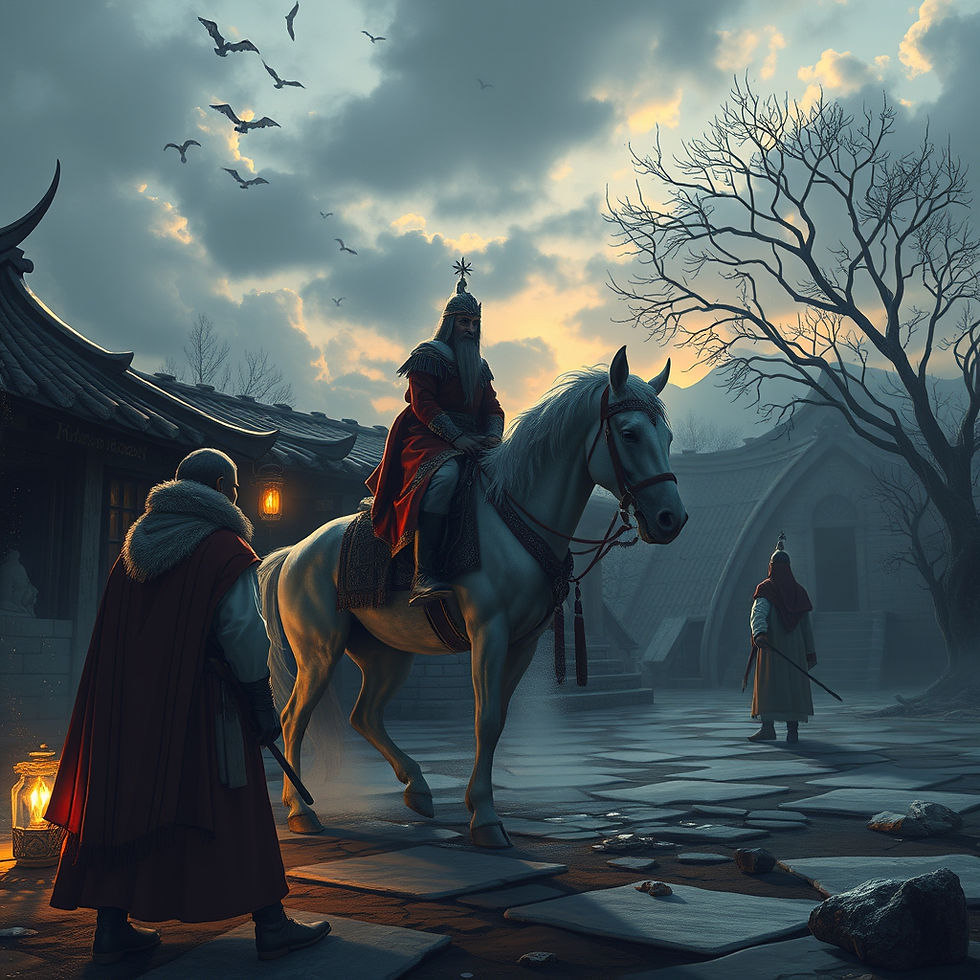
To his amazement, King Vedeha witnessed two silvery streams of tears flow down Matu Posaka’s sad face. The King went up to Matu Posaka and asked him affectionately the reason for his deep sorrow.
The grief-stricken Matu Posaka feebly got up on all fours. Upon taking a deep breath, he gave a loud trumpet that shook the city. King Vedeha was thoroughly shaken. For a moment, he thought that his Royal Mount had gone berserk and was about to attack him.
To King Vedeha’s great relief, Matu Posaka respectfully knelt at his feet and pleaded:
Virtuous King, you ask me why I am not happy. The plain reason is that I can never eat or sleep knowing that my aged and blind mother is alone in the forest pining for my return. Your Majesty, life is meaningless if I am unable to care for my dear mother who had risked her life to give birth me. She has sacrificed so much to nurse me and care for my needs since my birth.
King Vedeha was greatly moved by Matu Posaka’s nobleness. He thought to himself:
What a virtuous elephant this is. His love for his dear mother knows no bounds. He is truly a magnificent being. If only humans were half as noble, the world would be a divine place. I have terribly wronged this blessed elephant.
The King the patted Matu Posaka and praised him:
You are indeed a blessed creature to have the opportunity to look after your mother in her twilight years. Fret no longer, I will free you immediately so that you can be with your beloved mother once again and take care of her lovingly.
King Vedeha straightaway commanded the Keeper of the Royal Stable to free Matu Posaka. He also ordered heaps of food to be loaded for his dear mother.
The King declared to his subjects, “This noble elephant is a divine being. Let the name Matu Posaka be remembered for ever as a Paragon of Filial Piety.”
Matu Posaka was thrilled to the core of his being on hearing King Vedeha’s command to free him at once. He could not wait to attend to his dear mother. The people of Kasi cheered him on as he left the capital city. As soon as Matu Posaka reached the fringes of Candorana, he trumpeted merrily so that his mother could hear him from far. He was so excited that he romped through the thick jungle to be with his mother as soon as he possibly could.
It was a truly moving sight to watch mother and son in loving embrace as soon as they met. Tears of joy flowed freely from their glowing faces.
Kanthi smothered her beloved Matu Posaka as if he was a little calf. She praised him, “My dear son, I pray that all mothers are blessed with noble sons like you. My dearest, you are no ordinary elephant. You are a Deva! May you attain Nirvana my noble son!”
Kanthi was also greatly moved by the righteousness and compassion of King Vedeha. With deep gratitude in her heart, she sang in praise of the just King that is fondly remembered to this day:
Long live the compassionate ruler, King Vedeha of Kasi who freed my son.
May he bring boundless happiness and prosperity to his kingdom.
The King who has showed great respect to me as a mother, he deserves all praise.
May he be glorified forever as a shining example of a kind and just ruler,
Just as I rejoice to be with my noble loving son.
King Vedeha wished his subjects to follow the fine example of filial duty set by Matu Posaka. Bearing this objective in mind, the King instructed parents to sow the seeds of moral strength and the culture of honoring parents in their child from a young age. Children were taught in school to emulate the noble qualities of Matu Posaka, especially his boundless love for his dear mother.
Each year a grand festival was held to celebrate the filial piety of the noble Matu Posaka that came to be known as the Matu Posaka Festival. Throngs of people gathered to participate in the week-long celebrations. The finale was a grand procession of a magnificent statue of Matu Posaka taken through the main streets of Kasi. Over the years, the Matu Posaka Festival was observed all across India as well as beyond its shores in Persia, Sri Lanka, Southeast Asia, China, Korea and Japan.
Parents told their little ones the inspiring story of Matu Posaka’s joy and pride in honoring his parents and his devotion in taking care of his dear mother. They in turn narrated the story to their children. Thus, the great Matu Posaka Story lived on through the ages. Without a doubt, the deeply moving story will continue to inspire humankind of the joy of honoring parents in their living years for generations to come.
Understand and Reflection Time
It is important in education to facilitate a student to fully understand and reflect on the text than to put her or him through a routine exercise of posing questions to test whether he or she is able to give correct answers. For this, a learning culture of providing time for Understanding and Reflection instead of the conventional Reading and Comprehension Exercise is proffered. Such an approach to education would simultaneously render learning to be fun instead of being a boring chore.
Parents, care givers and teachers are urged to encourage the child to interact and improve their communication skills, thinking, comprehension and imagination as they help her or him to understand and reflect on the happenings in the story. They should make a deliberate effort to spend some time to discuss with their child salient aspects of the story and discuss the questions listed below as a facilitator:
What can you tell about Dhanapala’s parents?
How did Kanthi prepare for Dhanapala’s birth?
How did Saccaka bring up Dhanapala?
What impresses you about Dhanapala?
What lessons have you learnt from the story?
How do you aim to honor your parents?
How should we treat animals and why?
Why was Koroda disliked?
What was special about King Vedeha as a ruler?
Discuss why and how we should revive the Matu Posaka Festival.


Comments