Chinese basket story - Honour Thy Parents
Tan Ah Chong grew up in a remote farming village situated along the fringe of a thick forest. His village was located in the agricultural province of Henan which was not too far from China’s ancient city of Luoyang. His mother suddenly died due to an incurable illness when he was only 12 years old. So, his father, Tan Ah Know, looked after him.
Ah Know taught young Ah Chong all about farming and animal husbandry. He and his young son worked hard in the rice fields and a vegetable patch which he also owned. In addition, they reared some cows, goats and fowls to produce dairy products to sell in the local market to earn some extra income for their future needs.

When Ah Chong came to age, he got married to a pretty maiden named Wong Ai Lin who lived in the neighboring village. His parents and Ai Lin’s parents were close family friends. Ah Chong continued to live and work together with his father after getting married. It was customary in ancient China for newlyweds to live as an extended family with either of the couple’s parents. In most cases, the newly married couple would live with the husband’s parents. Only a few affluent families could afford to provide for their newly married children to start a home of their own. In the case of Ah Chong, since his father was a widower (goá phụ) and because he came from an average farming family, it made sense for him and his wife to stay together with his father under the same roof.
Ai Lin took care of all the household chores while Ah Chong and his father toiled in the rice fields and attended to the vegetable patch as well as the animals and fowls they reared nearby their home. She worked very diligently and attended to all the daily household work as efficiently as one could expect a wife to fulfill.
Ai Lin was also a marvelous cook and prepared delicious meals which Ah Chong and his father had dearly missed for so long. Since his mother passed on, Ah Chong and his father had to make do with simple meals. This usually comprised the staple diet of porridge or rice which they often ate along with salted fish, pickled vegetables and a soya bean-based dish. In addition, she would regularly attend to the laundry needs of the family as part of her daily chores. Ah Lin was also skilled in sewing which she leant from her mother. From time to time, she would sew new clothes for the family members and mend those which needed repair.
After several years of blissful married life, the young loving couple were blessed with a handsome cheerful son whom they named, Tan Ah Kim. His arrival brought great joy to the family. The parents and grandfather spent many happy times playing with baby Ah Kim whenever they had free time to spare. They would cuddle and kiss him as if he was a rare precious gift. He was such a cheerful and cute bundle of joy to everyone in the family. Little Ah Kin grew up to be an intelligent, kind-hearted lad. He loved his parents and his grandfather very dearly just as they loved him beyond measure. Ah Kim’s grandfather was particularly fond and very proud of his loveable little grandson. Daily without fail, he would spend enjoyable relaxing time playing and chatting with him in the morning before he left home to work in the fields and after he returned home in the evening.
Grandfather had lots of free time after he retired from working in the fields because of old age. Since then, he spent most of his retired life at home and taught Ah Kim many interesting and useful things about life. Ah Kim loved the fascinating folk stories which his grandfather told him. Grandpa also taught him many important things such as the meaning and significance of Chinese traditions, customs, values and festivals they celebrated throughout the year. These festivals usually coincided with the Full Moon Day of the month. So from a very young age Ah Lin learnt a great deal from the grandfather about Chinese culture. He also learnt other important things such as the realities of life and nature all around. His grandfather also took the trouble to teach Ah Kim moral and ethical teachings of the Buddha and about the meaning and purpose of the numerous Buddhist religious practices they observed in daily life.

Ah Kim was very fond of animals and spent a lot of time outdoors with grandpa. He and grandfather used to feed the cows and goats to help his father out with the heavy workload which he had now to attend all by himself. Ah Kim thoroughly enjoyed feeding the herds of cattle and goats and the coop of fowls under the careful supervision of his caring and loving grandfather. In the process, he learnt a lot about how to rear animals and about farming, based on his grandfather’s very wide first-hand experience in animal husbandry and in working in the rice field and vegetable patch.
Ah Kim and his farming family members lived a rather simple, yet contended and enjoyable life. Most of all, they lived as a loving, happy and caring family. As the years rolled on, however, his grandfather became progressively frail and weak so much so that he could hardly move about on his own. Before long, he had to depend on an adult to get about in the house. Usually this had to be Ai Lin as she was the one who stayed at home most of the day and attended to the daily household work. His father was only able to attend to his grandfather’s needs at night after he turned home from working in the fields. Aside from attending to the daily household responsibilities, Ai Lin now had to shoulder the additional task of nursing Ah Know. Being old and feeble, Ah Know would accidently mess up the table when it came to having his meals. He would often accidently spill food on the floor which Ai Lin had to end up cleaning the mess on the table and floor. Sometimes this would mean picking up broken bit of porcelain plates and bowls. Being clumsy, Ah Know would also accidently knock down things in the house. This would add to the already heavy burden of work; Ai Lin now had to cope with. Even so she would manage the household tasks as best as she could like a dutiful wife and mother.
But as the years rolled on, Ai Lin found it almost impossible too cope with looking after aged Ah Know. It came to a point that she felt it no longer possible for her to bear the burden of taking care and nursing him. So one day, when Ah Know and Ah Kim were asleep, she complained to Ah Chong about the difficulties and hardships his father was causing in the house. In response, Ah Chong lovely asked Ai Lin to be patient with his aged father. He expressed profound appreciation of her diligent efforts in managing the household chores so well. He requested her earnestly to continue likewise and attend to Ah Khow’s needs as best as she could with metta (unconditional friendliness, love or boundless goodwill) and karuna (compassion, kindness), understanding, love and devotion.
However, as time passed, Ai Lin’s complains about the hardships she faced in taking care of Ah Know became increasing frequent. At times this would end up in arguments between her and Ah Chong. Ai Lin would insist tearfully that life would be far better and more joyful for them if they lived separately without having to put up with Ah Chong’s burdensome old father. But Ah Chong would dismiss outright such talk and request Ai Lin to continue looking after his aged father with love, compassion kindness, tender (diuj dàng) care and patience.
As the days passed, Ai Lin’s complaints about attending to Ah Know became harsher. The situation in the home soon deteriorated into a regular ordeal for Ah Chong. Each night before Ai Lin retired after cleaning up the kitchen and washing up the pots and pans, she would complain to Ah Chong that it was simply impossible for her to look after his aged and sickly father any longer. She protested that he had now become totally dependent on her. At the same time, she had to manage the house as well as cook for the family. She complained that besides these pressing hardships, as the mother, she had to give increasing time and attention to Ah Kim
who was fast growing up. The situation reached a point that Ai Lin thought it timely to pressure Ah Chong to get rid of his father from the house for good. So after her usual round of complains, she suggested to Ah Chong that life would be far happier for them if his aged father was abandoned in the forest.
Ah Chong was rudely taken aback by Ai Lin’s suggestion. He pleaded that he just did not have the heart to do such a thing to his helpless father. He confided to her that he was completely at sea as how to deal with her recent never-ending complaints. He implored that he would have peace of mind and be far happier if she were to stop her daily nagging about his aged father. Ai Lin, however, continued to pounce on every opportunity she got to work on Ah Chong’s mind about how wonderful life would be if not for the ever-increasing burden she faced of looking after and nursing his aged father. She stressed that they would never be happy as a family as long as his father lived with them. She suggested that Ah Chong would in fact be doing his father a good deed by putting an end to his ever increasing suffering, due to his advanced age, by abandoning him in the forest. Ai Lin further stressed to Ah Chong that Ah Know’s frail physical condition would invariably worsen as he advances further in old age and becomes an invalid. She added that he will also be in greater pain and encounter all sorts of suffering in the days ahead. Furthermore, she gleefully expressed that there would be no bickering (cai nhau) between them and they would once again be able to live a blissful married life, just as when they were a newly married couple.
But Ah Chong simply refused to heed to Ai Lin’s pleas to abandon his father in the forest. Nevertheless (mac du vay), she persisted with her criticisms and protests until one night she broke down and cried bitterly. In between her tearful sobs, Ai Lin pleaded desperately: “Ah Chong, I cannot live with your father in the house any longer. Either he leaves the house or I will leave you and return to my parents along with Ah Kim. All you have to do is to put his father into the large rattan basket which we use to transport our farm produce to the market. You can then carry him into the forest and leave him here. You can easily do this in the wee hours of the morning when everyone is still fast asleep. We have already looked after him for so long now. He is not going to live much longer. There is no point in him suffering as an invalid.”
Ah Chong pleaded, “My dear Ai Lin, I have no heart to abandon my father. What am I to tell him where I intended to take him so early in the morning?” Ai Lin responded instantly to reinforce her request, “Ah Chong, your father is very pond fond of visiting temples and sacred religious places. You can trick him into believing that you are taking him on a pilgrimage. It would not be difficult to convince (thuyet phuc) him to agree to go with you as he loves to partake (mot phan) in religious activities. In fact, he will be delighted with the suggestion.”
While Ai Lin’s secret scheme was being unfolded, both she and Ah Chong were unaware that Ah Kim had been secretly listening to their most disturbing conversation. His mother’s loud complains and sobbing in the middle of the night had awakened him. He lay in bed and listened intently to his parent’s dreadful plan. He was thoroughly shocked when he eavesdropped (nghe trộm) on their scheme (âm mưu) to abandon his loving grandfather.
Sadness gripped Ah Kim’s tender heart. Tears began to well in his eyes. Soon red hot tears flowed down his checks cheeks. His mind whirled with many disturbing thoughts of the horrible fate his grandfather was about to suffer. He simply could not understand how his parents could ever think of getting rid of his dear old grandfather. He was so pained that he sobbed all through the night. He was determined to prevent his parents from caring out their horrible plan.
Well before the break of dawn (binh minh )the next day, Ai Lin helped to ready the large rattan basket to transport Ah Know. Ah Chong went up to his father and smilingly greeted him, “Sukhi hotu (may you be happy and well always) dearest Pappa”, in the traditional Anjali (with palms and fingers brought together in the formation of a lotus bud) posture (tu thế). In a voice cracking with guilt, he told his father, “Dear Pappa, Ai Lin and I have planned a delightful journey for you this morning. I am going to take Pappa on a wonderful pilgrimage to an ancient sacred vihara (temple). This will be a great outing as we both know how much you like to visit sacred religious places and famous temples.”

Ah Know responded with great delight: “That’s lovely my ever-loving son. But how shall I move around? I am barely (chỉ mới) able to walk even a few steps inside the house without Ai Lin’s help let alone step outdoors and walk around. I am afraid I am not physically up to it to go on a long journey, my son, thought I’d love to go on a pilgrimage.”
Ah Chong quickly replied in a reassuring (làm yên tâm) voice, “That should not be a problem, dearest Pappa. Ai Lin has kindly prepared the large rattan basket we use to gather our farm produce. You can be seated comfortably in it. I will carry you in the basket which will be safely strapped around my shoulders and waist. With great joy flushing all over his face, Ah Know spontaneously (tự nhien) remarked, “oh, I am so fortunate (may măn) to have such a wonderful son and daughter-in-law who treat me so lovingly. May you be blessed for being such a devoted caring compassionate couple. You are setting such a good example to Ah Kim. I pray that he will grow up to be a wonderful noble, loving and caring son.”
His father’s words brought tears to Ah Chong’s eyes. He had no heart to proceed with the plan to abandon his father in the forest. But before he could change his mind, Ai Lin swiftly pulled him aside and urged (thoi thuc )him to leave home on his “important pilgrimage” without any delay. She stressed (nhan mạnh) that it (trời) would be hot when the sun comes up. Ah Chong reluctantly(miem cuong) led his father to the rattan basket. Ai Lin quickly helped Ah Know to get into it and be seated comfortably inside.
Just as Ah Chong had strapped the rattan basket on his back (lưng) with Ai Lin’s eager help and proceeded to leave the house; Ah Kim, who had been secretly observing everything that was going on, appeared unexpectedly. Pretending to be unaware of what was actually taking place, Ah Kim inquired from his father, in a somewhat innocent voice, “Dear Pappa, where are you taking grandfather so early in the morning?”
Ah Chong kept on the lie that he and grandpa were going on a pilgrimage. He briskly walked towards the entrance of the house to embark on his journey with his father seated in the rattan basket. It was quite clear to Ah Kim that his father was very anxious (áy náy) to avoid any further awkward questions from him. Realizing this, Ah Kim quickly shot another probing question to his father, “Dearest Pappa, but a pilgrimage is a long journey, how are you going to carry grandfather on such a long journey?” Ah Chong replied hurriedly, “Well son, Pappa will manage (xoay xở )somehow to carry grandfather in the rattan basket. I will take short breaks along the journey to have a rest whenever I feel tired,”
It was obvious (rỏ rang) to Ah Kim that his father had been rattled (hoảng sợ) by his pointed questions and was feeling guilty (tội lỗi) and very uncomfortable in the awkward (bất tiện) questions. He decided that this was the right time to stop his father from carry out the cruel plan. He abruptly (bất ngờ )requested his father in a rather loud tone (tông giọng), “That’s fine Pappa, but please make sure that you bring back the rattan basket when you return home from your pilgrimage!”
Ah Chong was taken aback by his son’s puzzling (rối trí) request. He could not help but feel deep inside that Ah Kim knew about his real intention. He immediately arrested his steps, turned around quickly, and anxiously asked Ah Kim in a worried tone, “Son, why did you make that rather strange request for me not to forget to bring the basket back home?” Ah Kim replied with sadness to his father, “Dearest Pappa, it is not true that you are taking grandfather on a pilgrimage? I know that you are taking dear grandpa deep into the forest and leave him there to perish (chết). In the same way as you are about to treat grandfather in his old age; similarly, I will need the rattan basket to carry you deep into the forest and leave you there when you get old.”
Ah Chong at once realized his grave (nghiêm nghị ) folly (ý tưởng điên rồ). Tears filled his eyes. He immediately released the rattan basket from his back and dislodged his father from inside it. He seated his father gently on the stool (ghế đẩu) nearby, knelt at his feet and begged for forgiveness for his cruel plan. With tears now flowing profusely down his face, he vowed (lời thề) that he would never ever stop taking care of him. Ai Lin too realized her fault. She too worshiped Ah Know at his feet. She begged to be forgiven for the foolishness that overcame her in the moment of anguish and weakness of heart. Ah Chong then hugged Ah Kim tightly and thanked him repeatedly for preventing him from committing a grave unpardonable misdeed to his father. From that day onwards, Ai Lin unreservedly nursed Ah Know without uttering a single complaint against him or making a fuss for caring after him. She and Ah Chong respected his every wish in the traditional Buddhist culture of honouring parents and caring for their every need throughout life.
The age-old Buddhist moral story of the Chinese Rattan Basket has passed on from generation to generation in China in order to teach children the sacred duty to be ever grateful to their parents. They are taught to look after them with love and tender care. In addition, the important daily practice of, “Mata Pita Vandana” (Worshipping Mother and Father), was inculcated for children to imbue (thuấm nhuần), from a young age, the Buddha’s fundamental (nền tảng) teaching of being ever grateful to parents and honouring them daily. This entailed the daily practice of venerating one’s parents in the morning and also before retiring at night. Thus, the practice of honouring parents and filial duty became ingrained in Chinese culture as a key element in living a wholesome family life.
The noble culture of venerating parents daily includes the recitation of a stanza in Pali that is pregnant with meaning. The daily Buddhist, practice is also universally applicable. The daily expression of profound gratitude to parents begins with the Mata Vandana Gatha (Verse for Venerating Mother):
Dasa Mase Uraeykatva. Poseti Uddikaranaṃ
Ayu dighaṃ Vassasataṃ. Matu padam nama maham.
(For carrying me in your womb for ten lunar months; and for protecting and nurturing me so well;
I wish you a blissful life of a hundred years!
I worship you (at your feet) loving mother).
This recitation is followed by the Pita Vandana Gatha (Verse for Venerating Father):
Vuddhikaro Alingitva. Chumbitva Piya Puttakaṃ
Raja majjhaṃ supatitam. Pitu padam nama maham.
(I worship the feet of the dearest father who kissed and caresses me. For, when it comes to my welfare and interest, you place me amongst kings.
I worship you (at your feet) dearest father).
The daily practice of venerating parents at their feet has helped to imbue the Buddha’s sacred teaching of honouring parents as Brahma Virahas (celestial abodes) in the home. Along with the recitation of the Mata Pita Vandana, it is also customary (thường lệ) for a child to express sentiments (bieu hien tinh cam) of gratitude towards parents in Chinese or for that matter in any language. For example, this could be recited daily thus:
Dearest mother, I have no words to recount (thuật lại) the sacrifices (hy sinh) and hardships (gian khổ) you underwent from the day I was conceived (thụ thai) in your womb. I dearly worship you, loving mother. When I cried you lulled (ru ngủ) me to sleep soundly with utmost (hết sức) love and affection. You fed (feed=cho ăn)and nursed me so caringly. You even turned your blood to milk to breastfeed me. Oh, dearest mother; may you attain the highest bliss of Nibbana (Nirvana: ever-blissful abode devoid of suffering).
Dearest father, I am lost for words to recount the hardships and sacrifices you made for my welfare and well-being (sk hp) from the time I was born. Whenever I was upset or hurt in any way, you comforted me so tenderly. You cared for me and helped me in every possible way. I am forever grateful for your unconditional love that has always remained boundless. Oh, my loving father, may you attain Nibbana. I deeply worship you at your feet noble father.
This entrenched Buddhist practice in upbringing children explains why, finial piety has been deeply rooted in Chinese culture since ancient times. It will do well for parents to guide their children to follow this teaching of the Buddha of worshiping parents at their feet and reciting the Mata-Pita Vandana as a daily practice.
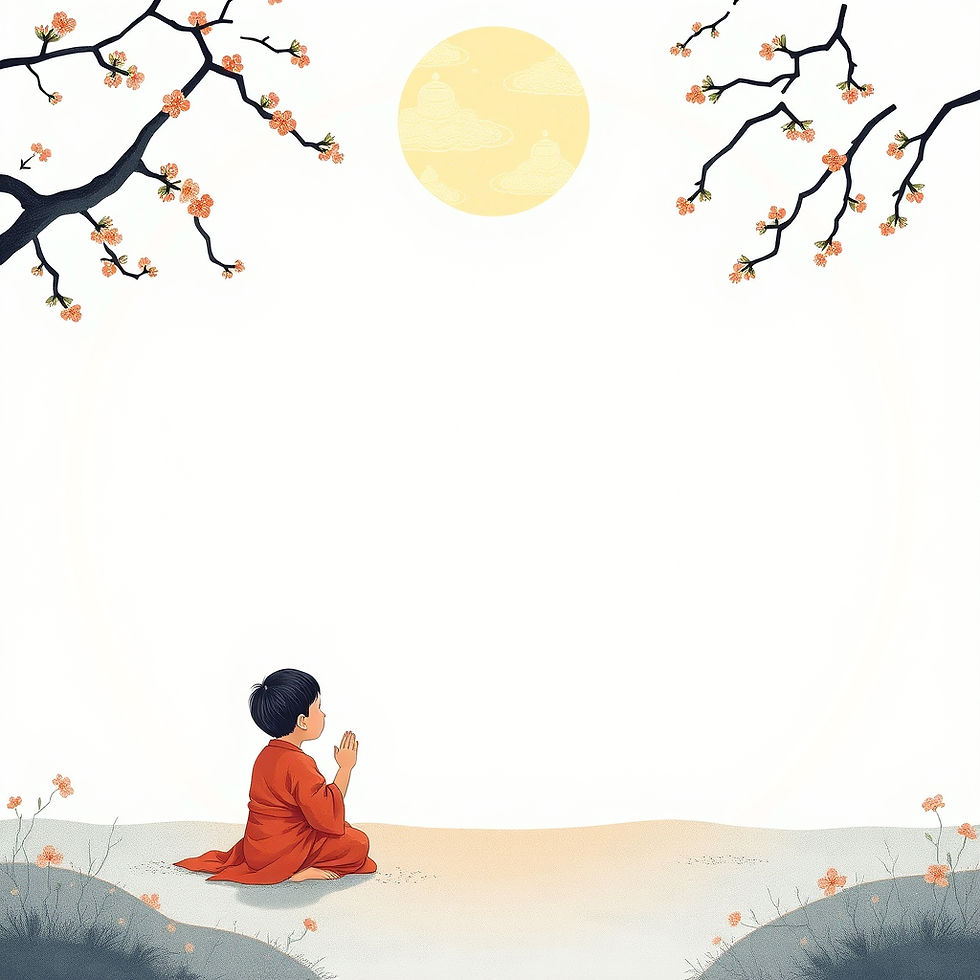
Understand, reflect and Internalize Parents, caregivers and teachers are urged to encourage to child to interact and improve her or his thinking, communication skills, comprehension and imagination. The onus is on them to make a full commitment to develop the child’s innate interest to inquire as well as learn new things as a skillful practice in developing a wholesome mental culture. They are urged to make a deliberate effort to spend quality time with their child by reading together with them the story, discuss the questions listed below and guide them to reflect on the important life-lessons in the story: Describe how Ah Chong was raised?
What can you tell about Ah Kim’s relationship with his grandfather?
Explain the situation that made Ai Lin complain about Ah Know.?
How did Ah Chong initially react to Ai Lin’s complaints about his father?
Describe how Ah Kim felt upon hearing his parent’s plan to abandon his grandfather in the forest?
How did Ah Kim make his parents realize that what they planned to do to his grandfather was wrong?
What was Ah Chong’s and Ai Lin’s promise to Ah Know after they realized their grave folly?
How should you treat and care for your parents?
Share your own fond relationships with your parents and grandparents.
Explain how filial piety became deeply rooted in Chinese culture.


Comments