Compassionate Emperor Ch’eng Tang
Many centuries ago, China was ruled by a powerful Emperor named Ch’eng Tang. He was a very wise and compassionate ruler. Under his able leadership, the Kingdom of Ch’u expanded in all directions from its busy, yet very beautiful capital city, named Ying.
The kingdom was so vast that it stretched northwards from the snow-capped Himalayan Mountain Range to the lush green grassy plains bordering the crystal clear deep blue waters of the South China Sea in the East. From its eastern coastline the kingdom stretched westwards for several thousands of kilometers to the remote desert regions that lay alongside its western frontier.

Though Ch’u was easily the most powerful kingdom in the region, it came under constant attacks by ambitious neighbors, particularly in the far North and the West who strove to conquer parts of its outlying territories. However, because of Emperor Ch’eng Tang’s sagacious rule, the kingdom remained united, strong and prosperous. In fact, it became renowned as one of the most powerful kingdoms in Chinese history.
As the Kingdom of Ch’u expanded, Emperor Ch’eng Tang built a very large army to protect his vast empire. In order to ensure the safety of the kingdom’s borders, the emperor travelled to the frontiers of the kingdom regularly. He was also keen to see for himself how the outer territories of his far-flung empire were being administered by his regional governors and officials.
Emperor Ch’eng Tang believed firmly that for good governance it was necessary to know from first-hand about the welfare of his subjects and the country’s security. He considered it unwise to merely rely on information submitted by the governors of the different regions about the conditions in the provinces under their administration.
The emperor therefore made it a point to personally verify the regular reports dispatched to him by his high-ranking officials stationed in the distant cities, towns and villages. In this way, he was able to have a firm grip on the government and administration as well as the welfare of his subjects. Further, through the practice of touring his empire regularly, Emperor Ch’eng Tang ensured that his subjects were hardworking, well looked after and lived contented lives.
The kingdom’s top military chiefs, senior governmental officials and palace staff accompanied the emperor on his regular royal tours to the different regions of the empire. The official tours involved traveling great distances across the kingdom. Usually, the Emperor’s inspection tours of the outer regions took several days.
The emperor’s large army and retinue of officials had to often camp and live in the open countryside while journeying on the long official tour. The Emperor Ch’eng Tang welcomed these royal outings as he was personally fond of the countryside where he could enjoy nature’s beauty in all its splendor, especially during spring and autumn.
Emperor Ch’eng Tang’s well trained, skillful and disciplined army helped to maintain peace and harmony among his subjects during normal times. For this and other considerations of maintaining the high level of defense and security, he followed a strict policy of appointing only brave capable generals to lead the many different divisions of the Imperial Army. The best among the brilliant warriors were commissioned as his personal bodyguards. The chief among them was a skillful and intelligent general named, Yang Youchi whom he very much trusted.
The handsome general, Yang Youchi, was renowned throughout the kingdom for his outstanding warrior skills. He was particularly famous for his superb mastery in archery. He was such an expert marksman that throughout his entire service in the army, he was known never to have missed his target. As a matter of fact, his archery skills were so perfect that he became a legend across the empire so much so that even animals in the jungle feared his excellent marksmanship with the bow and arrow.
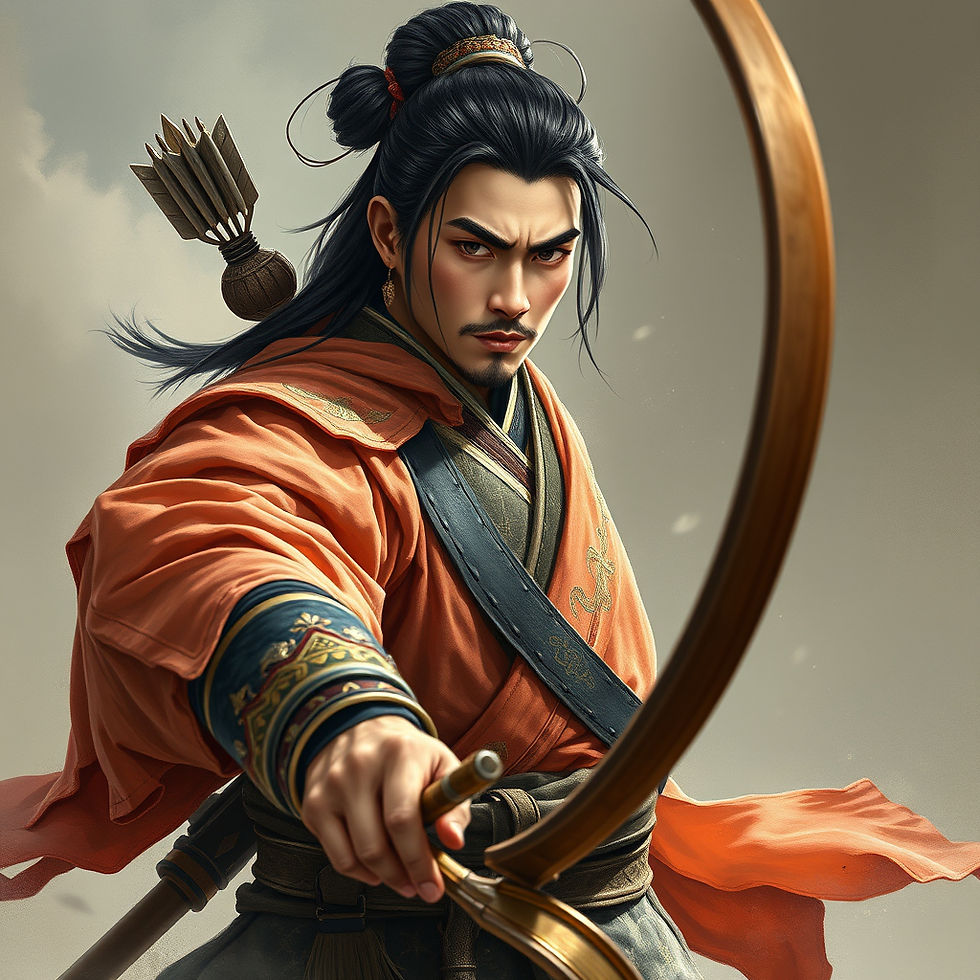
But as a moral principle of Ahimsa, (non-killing or causing of injury to other beings), as taught by the Buddha, Yang Youchi would not injure or kill any living being unless ordered to do so under the emperor’s command. Apart from his military capabilities, General (tuong quan) Yang Youchi was a devout Buddhist. He read the ancient Buddhist scriptures and was well versed in the moral, ethical and spiritual teachings of the Buddha.
He constantly reflected on the Buddha’s Sublime Teaching and made it a point to put it into practice in daily life. Every morning, he would without fail meditate for about half an hour. This was to strengthen his mental discipline and develop a wholesome mental culture through the practice of mindfulness meditation.
Emperor Ch’eng Tang naturally had great confidence in his abilities as a soldier as well as in his upright character and loyalty. The Emperor therefore assigned him to carry out special tasks from time to time. He also made it a point to include him the royal tours of the kingdom as his most trusted personal bodyguard.
On early spring, Emperor Ch’eng Tang decided to tour the western frontier of the kingdom as there were reports of foreign armies posing a threat along the kingdom’s borders. Furthermore, this was the most pleasant time of the year to travel across his sprawling empire. The air was pleasantly cool and refreshing throughout the open countryside. An array of flowers of different hues, shapes and formations decorated the landscape. Beautiful cherry blossoms in full bloom brightened the skyline with a myriad of colors.
The lush green grassy plains stretched as far as the eyes could see and appeared like a tempting soft green carpet to lie on restfully. The trees surrounding the grassy fields were filled with all types of juicy fruits, ranging from tasty mandarins, peaches, persimmons, pears to apples that were inviting for one to taste. Various nutty fruits such as chestnuts and walnuts too were in season.
For security reasons it was customary for the generals and soldiers to dress in full military gear when they accompanied the foot soldiers, cavalry men and a phalanx of horsemen on official tours. Their shiny metal weapons and armour glittered brightly in the bright morning sun as the columns of elegantly polished chariots rumbled across the plains.
The Emperor’s military convoy was a perfect picture of a formidable fighting force. This underlined the great military prowess of the kingdom. The military convoy conveyed a clear message that it would be unwise for anyone to try and challenge the Emperor’s authority.
Since the journey to the western frontier took several days, Emperor Ch’eng Tang and his large convoy broke journey to inspect the cities and towns they passed along the route. In order to keep his troops and generals physically fit and military prepared at all times, the Emperor made it a practice to hunt wild animals on his official tours.
Besides engaging in the sport of hunting, he felt that this vigorous outdoor activity would help his soldiers to perfect their warrior skills as well. He also made it a practice for his soldiers to engage in war games to tone up their fighting spirit and military preparedness.
After several days of travel, Emperor Ch’eng Tang and his troops arrived at the fringe of a dense forest. As it was mid-day, the Emperor decided to have a rest and have lunch under the shade of a canopy of huge walnut trees. No sooner than he alighted from his royal carriage, a loud hostile sounding chatter grabbed his attention. Nearby, amongst a cluster of walnut trees, he spied a large monkey perched on a huge branch causing the irritating chatter.

The lone monkey showed scant respect for the Emperor’s presence. It began to mock the generals that had now moved towards the foot of the walnut tree to shoo it away to ensure some peace and quite for the Emperor. Instead of bolting from the scene, the monkey gathered some walnuts and threw them at the soldiers below. One of the walnuts hit the left eye of a senior general. It was so painful that his eyes began to tear in acute pain.
The general was so furious with the monkey that he at once drew an arrow from his quiver and shot at it. But the agile monkey sprang to another branch in the nick of time. The arrow just hissed past its body and landed on a nearby branch. The cheeky monkey then began to mock the general by making funny faces. The soldiers who watched the antics of the monkey burst out into a hearty chorus of laughter. This encouraged it to tease the general even more boldly.
Mindful of the humiliation inflicted upon his colleague in the presence of the soldiers, a senior general at once got off his horse to take a shot at the teasing monkey. With his bow string drawn to the maximum, he took careful aim at the monkey and released it swiftly. It made a loud twang and his arrow pierced straight through the air towards the targeted monkey. But the monkey was not perturbed at all.
To the amazement of everyone present, the monkey remained calm and plucked the arrow from the air with its right hand as it swiftly side-stepped from where it had perched. It then mockingly sniffed the arrow and fanned its left hand across the nose to express that it smelt rotten. It then broke the arrow into two as if to show utter contempt of the general’s archery skills. The troops were now more amused by the monkey’s taunts and broke out into loud chuckles.
Emperor’s Ch’eng Tang was furious at the humiliation the teasing monkey had inflicted upon his two generals. He was concerned that the respect of his senior generals in the eyes of the troops had to be immediately redeemed for otherwise they would not be able to command their respect and lead them effectively. Thinking thus, he commanded the Kingdom’s expert archer, Yang Youchi, to put an end to the disrespectful monkey, with his bow and arrow, and redeem the honor of the senior generals.
As soon as General Yang Youchi stepped forward and got his bow and arrow to take a shot; the monkey began to cry out loudly like a little helpless baby. It understood full well that it would surely be killed. It knew the reputation of the General of being a brilliant marksman. It feared that the arrow would surely pierce right through his heart. Sorrowful tears flowed down the monkey’s sad face like two little silvery streams.
Emperor Ch’eng Tang was thoroughly puzzled by the dramatic change in the monkey’s hitherto unsavory behavior. He was curious to know as to why the rude monkey had begun to tear profusely and cry so loudly when just a moment ago it had boldly mocked and teased his generals. Moreover, this was the first time the emperor had seen an animal cry so pitifully. He could not help feeling sad at the sight of the monkey shrieking like a little helpless baby lost in the forest and desperately looking out for its mother.
The scene of the wailing monkey had a profound impact on Emperor Ch’eng Tang. The perplexed Emperor felt that the strange behavior of the monkey was meant to convey a special message. Perhaps there was a deeper meaning to what he had witnessed, he thought to himself. He immediately ordered General Yang Youchi not to shoot the monkey. Trusting the deep wisdom of the General, the Emperor requested him to explain the monkey’s most unusual behavior.
General Yang Youchi fully understood the cause of the monkey’s great sadness. He went up to Emperor Ch’eng Tang, bowed respectfully and explained:
Your Majesty, the monkey is fully aware of my capabilities with the bow and arrow. It knows that I never miss my target. It realizes that however agile it may be, if I were to shoot my arrow, it will surely pierce right through its heart and kill it instantly. Knowing that it faces certain death, the monkey could not help but cry with deep anguish.
My Majesty, I have no heart to kill the monkey. Please reconsider Your Majesty’s command and spare the monkey life. It truly meant no harm to any of us. It was merely behaving as monkeys always do. By nature, they are mischievous and like to tease human beings.
They are basically harmless, defenseless creatures. This episode underlines a profound moral lesson of Ahimsa that the Buddha taught. Just as we humans do not wish to be hurt or killed, animals too love their life. They too do not wish to be harmed, and much less, do they wish to be killed.
Emperor Ch’eng Tang was deeply moved by General Yang Youchi’s explanation about the moral lesson behind the behavior of the monkey. Compassion filled his caring heart. He reflected deeply on the regular hunts he undertook on his royal tours of the outlying regions. He was overwhelmed by deep remorse over the suffering inflicted on the animals that was hunted. His heart was filled with repentance over the pain and suffering these innocent animals must have experienced when the arrows and spears ruthlessly pierced their bodies.
After deep contemplation, the emperor addressed his generals and soldiers:
I have spared the monkey’s life. I realize that it has not done any wrong except to behave in a mischievous manner. It is in the very nature of monkeys to create mischief and tease human beings which we need to understand and accept. There is therefore no reason for anyone of us to feel angry towards the mischievous monkey. Further, having realized the cruelty involved in hunting wild animals, I call off the royal hunt forth with. I decree that henceforth my official royal tours of the kingdom would not include the hunting of wild animals.
The emperor’s tour of the outer western regions of the Kingdom was cut short because of the royal decree against hunting of innocent animals. The city folks wondered why their Emperor had returned from his official tour much sooner than expected. They felt awed when they learnt that this was because their Emperor had been moved by the sadness of the monkey that was about to be killed by General Yang Youchi. The people of Ch’u were impressed and gratified over their Emperor’s deep compassion and sang praises about his noble character and profound kindness.

In the course of his reign, Emperor Ch’eng Tang introduced numerous laws to ensure that all his subjects were well treat. He paid great attention towards the welfare of animals and set up numerous veterinary clinics throughout the kingdom for sick, injured and stray animals to be treated and well looked after. In addition, he builds hospitals all across the country for expectant mothers to have pre-natal care and promoted the culture of honoring motherhood as sacred.
This policy was based on the Buddha’s teaching of Gabbha Parihara, that is, the science of practicing holistic mother care, referred to in Chinese as Tai Cheow. Thus, was encouraged in Chinese culture a deep spiritual practice of honoring motherhood as sacred. Not only was the physical development of the unborn baby carefully nurtured, but also her or his emotional, mental and spiritual development while growing in the mother’s womb. In the same spirit of kindness and compassion, the emperor-built schools that provided opportunity for children even in remote villages to have a basic education and understanding of the Buddha’s Sublime Dhamma.
When Emperor Ch’eng Tang passed on at the ripe old age of 110 years, a series of grand festivals were held throughout the kingdom to celebrate the glorious reign of the much admired and loved monarch. A giant statue of the Compassionate Emperor was sculptured and placed in the center of the royal park in the capital. Ever since, on his birthday, a grand procession carrying the statue of Emperor Ch’eng Tang was taken round the capital city to celebrate his noble compassionate character. The joyous celebration was to remind the people of Ch’u of their famous compassionate ruler. To this day, Emperor Ch’eng Tang is fondly remembered as one of the most glorious and compassionate rulers in Chinese history.
Understand, Reflect and Internalize
Parents, caregivers, and teachers are urged to encourage the child to interact and improve her or his thinking, communication skills, comprehension and imagination. The onus (trách nhiệm, nhiệm vụ) is on them to make a full commitment to develop the child’s innate nature to inquire into new things. They are urged to make a deliberate effort to spend quality time with their child by reading together with them story, discuss the questions listed below and guide them to reflect on the important life-lessons in the story:
1. Describe the ancient Chinese Kingdom of Ch’u.
2. How did Emperor Ch’eng Tang rule his kingdom?
3. Describe the character of General Yang Youchi.
4. What do you understand about the nature of monkeys?
5. Why did the mischievous monkey begin to cry?
6. Explain General Yang Youchi’s feelings towards the monkey?
7. What effect did the episode of the crying monkey have on Emperor Ch’eng Tang?
8. What did Emperor Ch’eng Tang feel and do upon understanding the moral behind the monkey’s crying?
9. How did the people of Chu regard Emperor Ch’eng Tang?
10. What moral and ethical lessons have you learnt from the story?


Comments